
Anti-Racism & Anti-Hate Network
Share Your Experience. Explore Your Options. Connect with Support.
Everyone deserves to feel safe, respected, and included in their community.
Have you experienced or witnessed racism, discrimination, or hate?
You may feel unsure about what happened, whether to report it, or where to find support. You do not have to figure everything out on your own.
qathet Community Justice (qCJ) participates in the Resilience BC Anti-Racism Network, supporting local efforts to address racism and hate in the qathet region and the Sunshine Coast.
We work to strengthen community relationships, increase awareness, connect people with resources, and coordinate local responses to racism and hate.
How Can We Help?
Our Anti-Racism & Anti-Hate Spoke Community Coordinator can help you:
-
Share your concerns: Provide a respectful starting point to tell us about an experience of racism or hate.
-
Understand available options: Learn about possible ways to respond, including reporting an incident to an appropriate organization.
-
Connect with community resources: Explore available services and organizations that may be able to help.
-
Understand police reporting: Receive information about how to contact police if you choose to make a report.
-
Explore restorative approaches: Learn about restorative justice, including peacemaking circles, when appropriate and available.
-
Support community change: Help identify local concerns that may inform anti-racism education, awareness, and community responses.
You do not need to make a police report before contacting us.
Our approach respects your dignity, personal choices, cultural background, and lived experiences.
What Is a Hate Incident?
A hate incident may involve harmful actions or hostility toward someone because of their identity or perceived identity.
This may include race, colour, ancestry, place of origin, religion, disability, sex, sexual orientation, gender identity or expression, age, or another identifiable characteristic.
Examples may include:
-
Racist or hateful language, comments, or harassment
-
Threats, intimidation, or violence motivated by hate
-
Hate symbols or messages displayed in public spaces
-
Online hate or harassment
-
Targeting someone because of their identity or background
Some hate incidents may be criminal offences. Others may not meet the legal definition of a crime.
Even when an incident is not a crime, it can still cause harm and deserves attention.
Share Your Experience or Request Information
If you have experienced or witnessed racism or hate, you can contact us through our online form.
You can choose to:
-
Tell us about an experience or concern
-
Ask for information or resources
-
Request a follow-up from our coordinator
-
Ask about reporting or restorative justice options
You only need to share information you feel comfortable providing. We encourage you to avoid including unnecessary personal or sensitive details in your first message.
Share Your Experience / Request Support
Your Privacy Matters
We understand that sharing an experience of racism or hate may be difficult and involve sensitive personal information.
qathet Community Justice (qCJ) collects information to review your inquiry, provide requested follow-up, and help connect you with appropriate information and resources.
We collect only the information necessary for these purposes. We aim to protect your privacy and respect your choices. Confidentiality may have limits under applicable law.
Please do not include unnecessary personal information about yourself or others in your initial message.
For more information, please review qCJ’s Privacy and Confidentiality information.
Please note: Our Anti-Racism & Anti-Hate Coordinator works part-time. This form is not monitored continuously and is not an emergency service. For immediate danger, call 911.
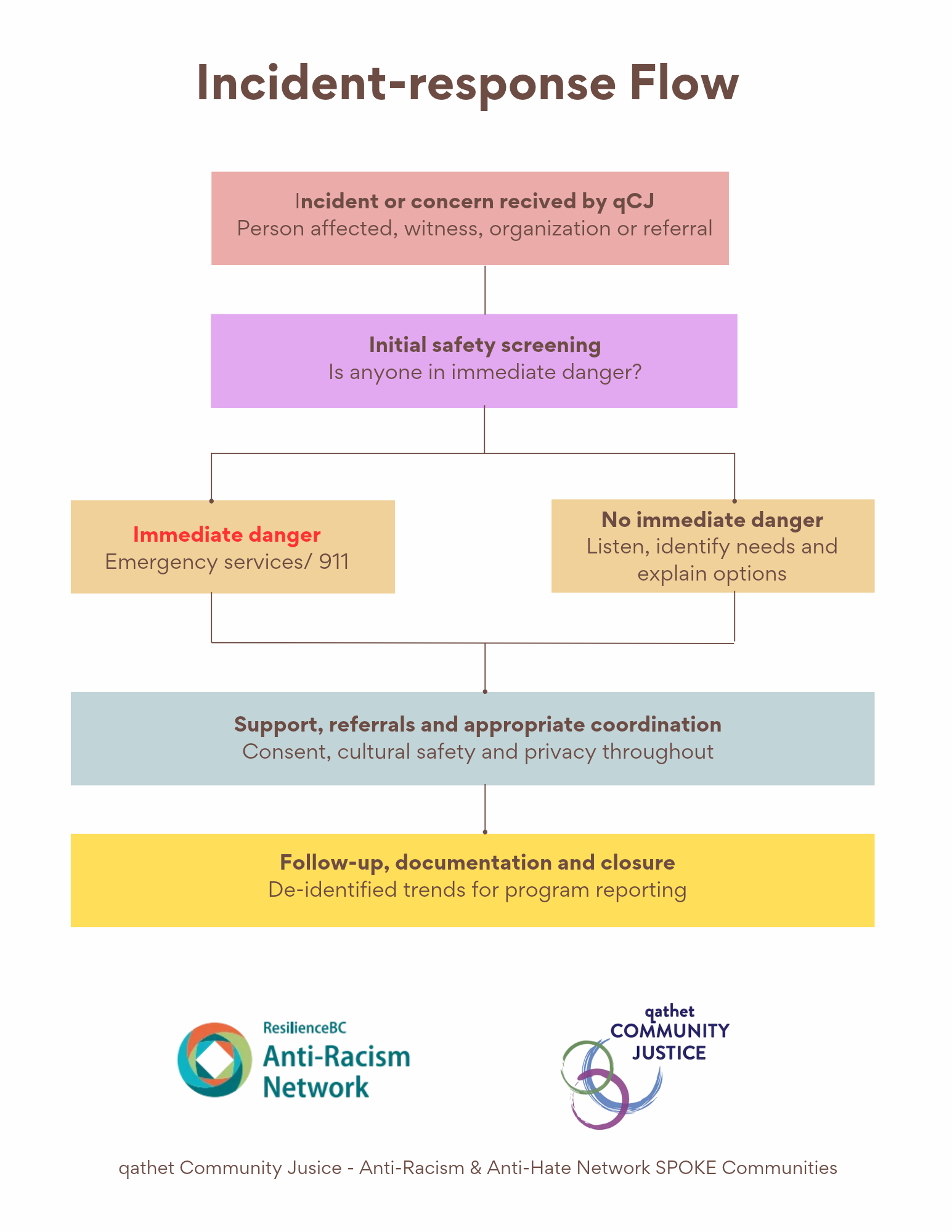
What Happens After You Contact Us?
Step 1: We receive your message.
Your message will be received through qCJ’s designated contact system.
Step 2: We review your request.
Our coordinator will review requests during scheduled working hours.
Step 3: We explore your options.
If you request contact and provide a safe way to reach you, we can discuss your concerns, available resources, and possible next steps.
Step 4: We identify appropriate support.
Depending on your needs, this may involve connecting you with community organizations, explaining reporting options, or exploring whether a coordinated community response is appropriate.
Step 5: Follow-up.
If you would like further support, we may follow up to check how things are going, discuss any additional needs, and help you connect with other resources. We respect your choices and will only continue communication with your consent.
Need Immediate Assistance?
If you or someone else is in immediate danger, call 911.
Our online form is not monitored continuously and is not intended for emergency situations.
For more information about racism and hate, visit Resilience BC.
Do I Need to Contact the Police?
No. You do not have to report an incident to the police before contacting qCJ.
Some people may want to make a formal police report, while others may prefer to seek information, community support, or other options first.
We recognize that people have different experiences with police and reporting systems.
We aim to support you in understanding your options and making informed decisions.
Contacting qCJ does not automatically create a police report. Any sharing of personal information with another organization will be subject to applicable privacy requirements and limits to confidentiality.
Can Restorative Justice Help?
Restorative justice offers an approach to understanding harm, supporting affected people, encouraging accountability, and exploring ways to repair relationships and communities.
In some situations, a restorative process such as a peacemaking circle may be considered.
Restorative justice is voluntary and is not appropriate in every situation. Safety, consent, readiness, and the needs of the people involved must be carefully considered.
You will not be expected to meet or communicate with someone who caused harm simply because you contacted qCJ.